

Posebyen Backstage
Jeg og Leon Muraglia har jobbet sammen i mange år. Vi kjenner hverandres uttrykk godt og har utviklet et felles språk gjennom en rekke prosjekter – fra The Whiteforest Hotel på Sørlandet sykehus til Not Just an Angel i Kristiansand domkirke, Your Blue Ocean på Aquarama, Highway Honey langs Riksvei 9 og Absence for Sørlandets Kunstmuseum og Tangensamlingen.
Vi bruker mye tid på dramaturgi. På hvordan lyd, rom, bevegelse og tablåer kan spille sammen.
Jeg bruker sjelden ord i performancene mine. Jeg arbeider med kroppen, materialene og det visuelle. Leon skaper lydlandskap og atmosfærer som kan påvirke opplevelsen uten å forklare den.
Denne gangen inviterte jeg ham inn i malingen og arbeid med figuren. Uten å tenke dramaturgi eller historie.
Leon har ikke tidligere vært med i mine maleprosesser, så vi rigget oss til i studioet i Posebyen med store malerflater, maling, instrumenter og høyttalere.
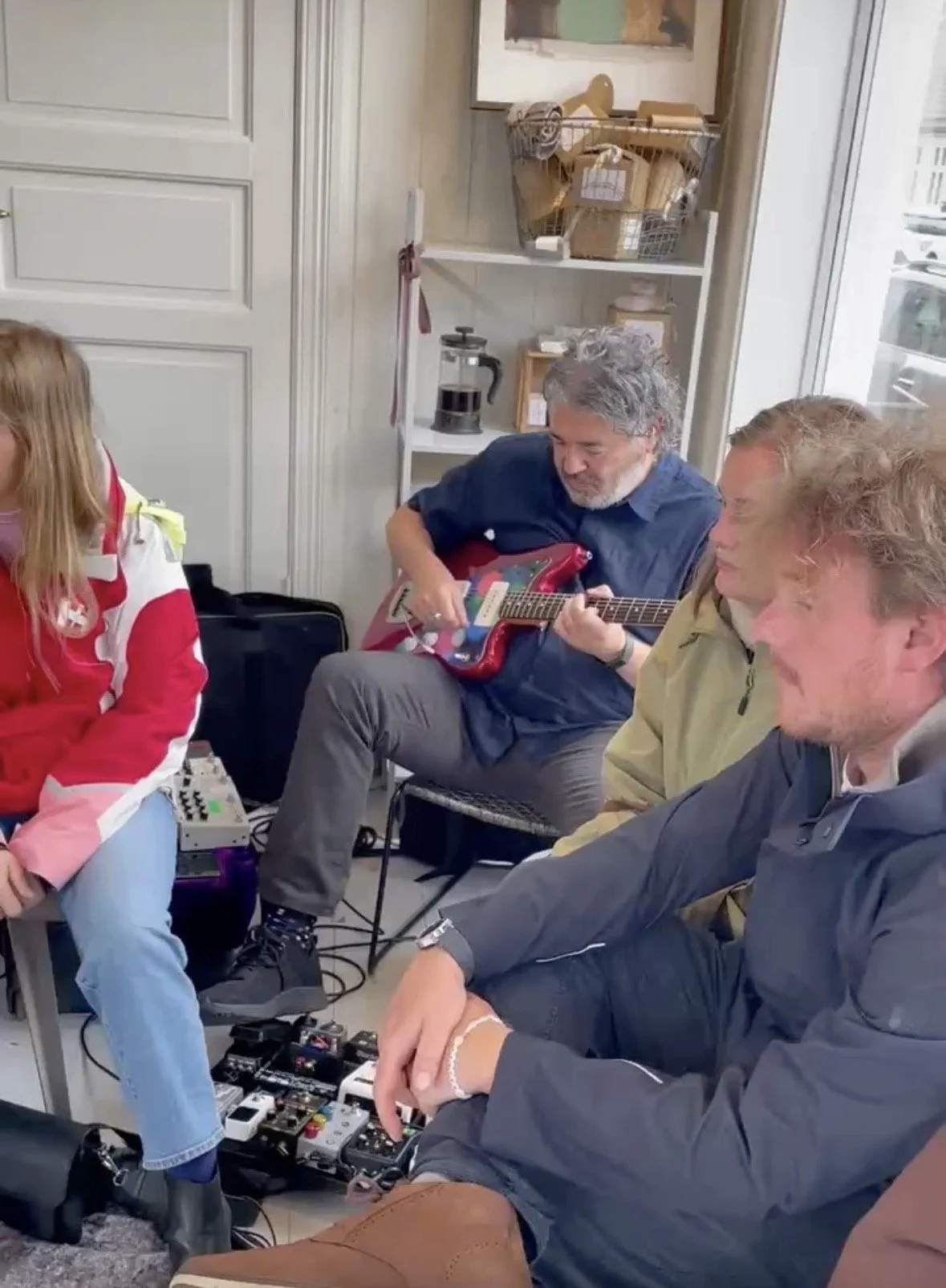
Da de første ti menneskene kom, ble studioet ganske fort fullt. Noen satt inne, andre så gjennom vinduene eller inn gjennom døren. Publikum bestod av studenter fra kunstfag ved UiA, kollegaer fra kunstfeltet, nysgjerrige forbipasserende og noen som hadde funnet prosjektet på sosiale medier.
Så begynte vi. Malingstrøk på to tre meter lange akvarell-ark, gitaren til Leon; lydene og fargene som spredte seg i hele rommet.
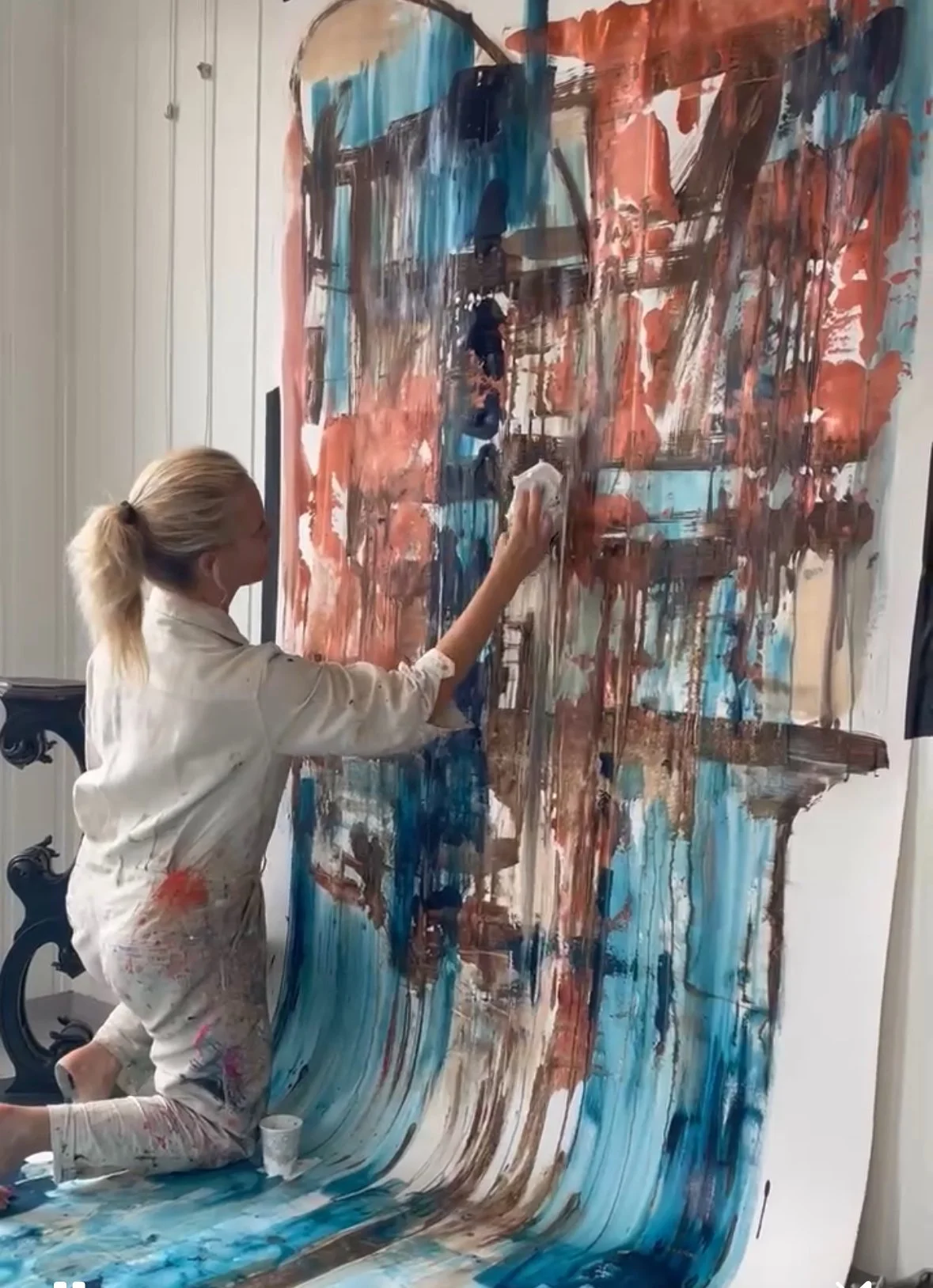
Det ble to timer med improvisasjon.
Leon bygget opp et lydlandskap som hele tiden forandret seg, mens jeg arbeidet med malingen, de store flatene og figuren. Det ble fysisk, intenst og suggererende. Vi tok en liten pause etter litt over en time, før vi fortsatte.
Noen gikk underveis. Andre kom til. Og det var interessant å kjenne på hvordan publikum ble en del av situasjonen, som tilstedeværende kropper i rommet. Når du vanligvis står på en scene, finnes det en tydelig avstand mellom deg og publikum. Her var den nesten borte. Jeg kunne høre små bevegelser, merke folk som kom og gikk og kjenne at rommet hele tiden forandret seg.
For meg er dette også en del av det jeg ønsker å undersøke med Posebyen Backstage.
Hva skjer når kunsten kommer litt nærmere?
Når man ikke trenger å kjøpe en billett eller ha bestemt seg på forhånd for å oppsøke en kunstnerisk opplevelse? Noen kom fordi de kjenner kunstfeltet. Andre fordi de var nysgjerrige eller tilfeldigvis gikk forbi. Jeg er opptatt av hvordan kunst kan være en aktiv del av byen og samfunnet rundt oss. Ikke bare som et ferdig resultat vi oppsøker, men som noe som kan skape nysgjerrighet, møter og samtaler underveis.
Det betyr ikke at alt skal åpnes. Men noen ganger kan det være interessant å åpne døren litt og se hvem som kommer inn.
Da vi var ferdige, var jeg helt utslitt. Det var varmt, fysisk og intenst – og utrolig herlig å få lov til å forsvinne inn i arbeidet så lenge.
Etter denne første kvelden begynte jeg å tenke på rommet. Studioet var fullt, og jeg ble nysgjerrig på hva som kunne skje dersom vi fikk mer plass – både til arbeidet og til menneskene som ønsket å oppleve det.
Så jeg tok kontakt med Kildens teatersjef.
Og det ble starten på neste kapittel i Posebyen Backstage. Men først hadde jeg en avtale med Haavard Tveito og digitale projiseringer.
Posebyen Backstage is part of the development of The Poetry of Rising Echoes, supported by Cultiva and Kristiansand Municipality. Their support has given me the space to explore, invite other artists into the process and open parts of the work to the people around it.
English readers: Leon Muraglia and I have worked together for many years. We know each other’s artistic language well and have developed a shared vocabulary through a range of projects – from The Whiteforest Hotel at Sørlandet Hospital to Not Just an Angel in Kristiansand Cathedral, Your Blue Ocean at Aquarama, Highway Honey along Route 9, and Absence for Sørlandet Art Museum and the Tangen Collection.
We spend a great deal of time working with dramaturgy – exploring how sound, space, movement and tableaux can interact.
I rarely use words in my performances. Instead, I work with the body, materials and visual expression. Leon creates soundscapes and atmospheres that can shape an experience without explaining it.
This time, I invited him into the world of paint and the work with the figure. Without thinking about dramaturgy or narrative.
Leon had never previously been part of my painting process, so we set ourselves up in the studio in Posebyen with large surfaces, paint, instruments and speakers.
When the first ten people arrived, the studio filled up rather quickly. Some sat inside, while others watched through the windows or from the doorway. The audience included students from the Fine Arts programme at the University of Agder, colleagues from the art field, curious passers-by, and people who had discovered the project through social media.
Then we began.
Brushstrokes across a two-by-three-metre sheet of watercolour paper. Leon’s guitar. Sounds and colours spreading through the entire room.
It became two hours of improvisation.
Leon built a soundscape that constantly shifted and evolved, while I worked with the paint, the large surfaces and the figure. It became physical, intense and immersive. We took a short break after a little more than an hour, before continuing.
Some people left along the way. Others arrived.
It was interesting to feel how the audience became part of the situation – as bodies sharing the space with us. When you usually stand on a stage, there is a clear distance between performer and audience. Here, that distance had almost disappeared. I could hear small movements, notice people coming and going, and feel the room constantly changing.
For me, this is also part of what I want to explore through Posebyen Backstage.
What happens when art comes a little closer?
When you do not have to buy a ticket or decide in advance to seek out an artistic experience?
Some people came because they already knew the art scene. Others came because they were curious, or simply happened to pass by. I am interested in how art can become an active part of the city and the community around us. Not only as a finished result that we seek out, but as something that can create curiosity, encounters and conversations along the way.
That does not mean that everything needs to be open. But sometimes it can be interesting to open the door a little – and see who comes in.
When we finished, I was completely exhausted. It was hot, physical and intense – and incredibly wonderful to be able to disappear into the work for that long.
After this first evening, I began thinking about the space itself. The studio was full, and I became curious about what might happen if we had more room – both for the work and for the people who wanted to experience it.
So I contacted the artistic director of Kilden Theatre.
And that became the beginning of the next chapter of Posebyen Backstage.
But first, I had an appointment with Håvard Tveito – and digital projections.
Posebyen Backstage is part of the development of The Poetry of Rising Echoes, supported by Cultiva and Kristiansand Municipality. Their support has given me the space to explore, invite other artists into the process and open parts of the work to the people around it.